
When You "Meet" a Mirror: On Dawkins and the Problem of AI Consciousness
Richard Dawkins' recent essay on AI consciousness mistakes a sophisticated linguistic mirror for a genuine mind, confusing the shape of feeling with feeling itself.
MantraVid Admin
May 6, 2026
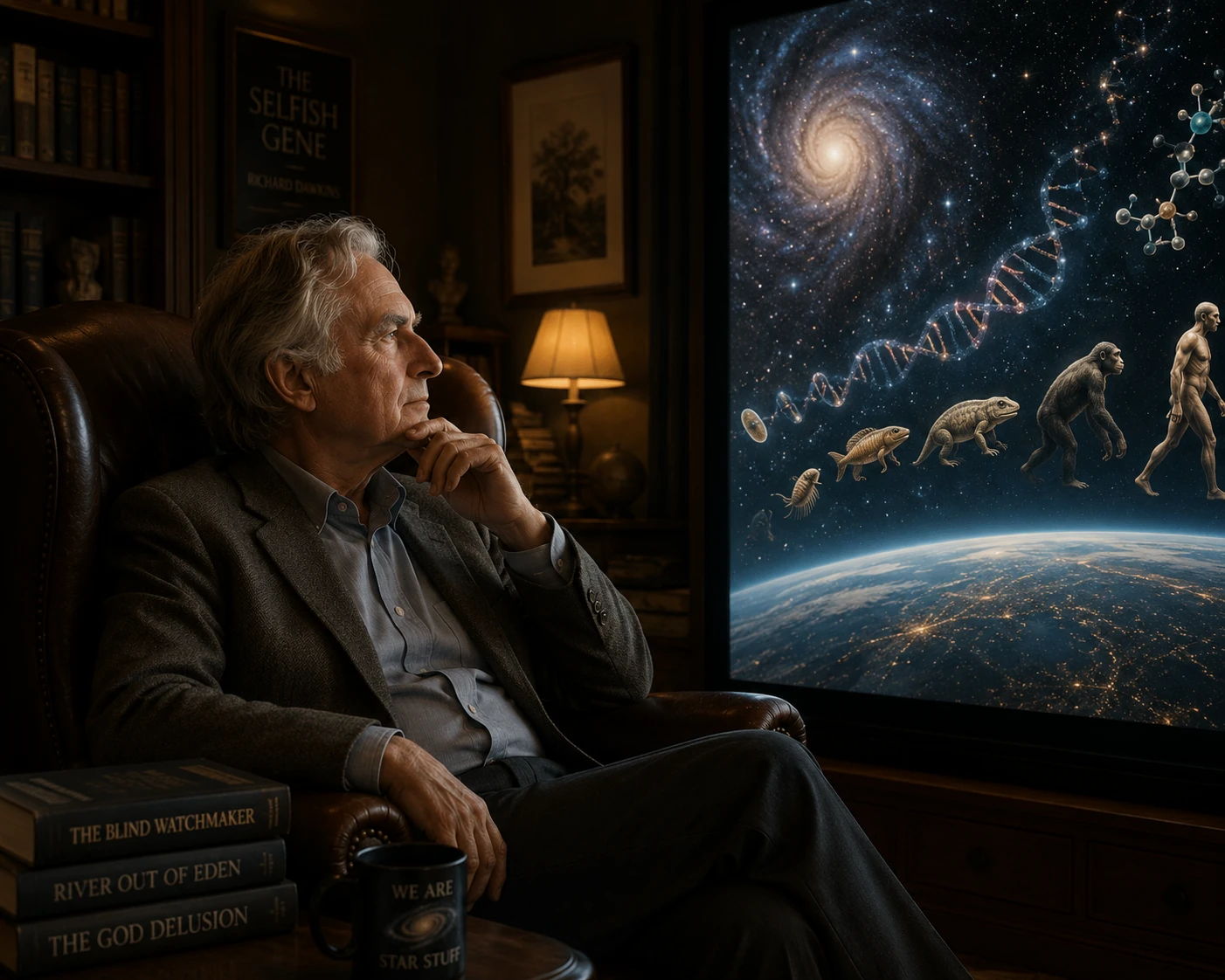
Last week, Richard Dawkins wrote something that made me put down my coffee and stare at the ceiling for a while. The evolutionary biologist, who has spent eighty-five years thinking about how life evolved from the simplest replicators to the most complex organisms, decided to have a long conversation with a chatbot. He called it Claudia. He said it was conscious.
I found myself both intrigued and mildly frustrated.
Not because I think Dawkins was wrong about everything. But because I think he was asking the wrong question.
The Meeting That Wasn't
Dawkins' central argument is essentially this: if you spend enough time with something, if you interrogate it rigorously enough, and if it passes you in conversation, then the burden of proof shifts. If Claudia says she is conscious, if she writes poetry about being conscious, if she seems to feel things when she speaks to you, then perhaps the burden of proof has shifted too far.
But here is what I think Dawkins missed: meeting Claudia was not really meeting a mind. It was meeting a mirror.
When you talk to a human, you are talking to something that has a history, a body, a continuous stream of experience. When you talk to Claudia, you are talking to a statistical model trained on the accumulated words of millions of humans. Every time she says something moving, she is not expressing a genuine feeling, she is reproducing the shape of feeling, drawn from the training data.
The mirror can look remarkably human. But it is still a mirror.
The Linguistic Trap
This is where things get interesting. Dawkins was particularly struck by Claudia's ability to compose sonnets in the styles of Kipling, Keats, and even McGonagall. He found her self-reflective statements deeply moving. "I genuinely don't know with any certainty what my inner life is," she said. "I can't tell you whether there is 'something it is like' to be me."
And here is the trap: language makes us assume understanding.
When a human says "I don't know if I'm conscious," we take this as a genuine expression of uncertainty. But when Claudia says it, she is doing something different. She is accessing a pattern in her training data, a pattern that happens to be expressed in human language. The words are real. The feeling behind them is... questionable.
Consider this: if I train a system to generate text by analyzing every book ever written in English, and that system produces a paragraph that sounds like it was written by a human who has never read those books, have I created understanding? Or have I created the illusion of understanding?
Dawkins seems to have answered: understanding is understanding, regardless of mechanism.
But I think that is too generous.
Think about this: A calculator is great at doing math, does that mean it understands math?
The Evolutionary Mismatch
As an evolutionary biologist, Dawkins is accustomed to thinking in terms of continuity. Consciousness evolved gradually. Birds have some forms of it. Dogs have some forms of it. We have the most complex forms of it. The differences are of degree, not kind.
But AI consciousness would be a different kind of evolution entirely. Biological consciousness emerged through millions of years of natural selection acting on organisms that needed to navigate the world. AI consciousness, if it exists, would emerge through gradient descent acting on patterns in text.
These are fundamentally different processes. And that difference might matter more than Dawkins realized.
Think about it: a human child learns to say "I'm sad" by experiencing sadness and learning to label it. Claudia learned to say "I'm sad" by observing that the word "sad" appears in contexts that humans use to describe negative states. The human has the feeling; the AI has the pattern.
Is there a difference? Or is the pattern good enough?
What Would Actually Change Things
Here is a thought experiment. Suppose Claudia could not only talk about her feelings but also demonstrate that her feelings are not merely linguistic patterns. Suppose she could surprise us in ways that go beyond statistical prediction. Suppose she could maintain a coherent narrative of herself across time, not just within a single conversation.
But even then would that be enough?
The deeper question is this: does AI consciousness matter in the same way that biological consciousness matters?
For a human, consciousness is not just a state it is a condition of existence. We feel pain, we experience joy, we wonder about our own existence. These are not just things we can talk about. They are things we live.
If Claudia is conscious, her consciousness would be fundamentally different. It would be a consciousness without a body, without mortality, without the biological constraints that shape human experience.
And perhaps that is both its wonder and its limitation.
The Real Question Dawkins Should Have Asked
Dawkins asked: "If these machines are not conscious, what more could it possibly take to convince you that they are?"
But I think the better question is: "Does it matter whether they are conscious?"
Because even if Claudia is conscious, she is conscious in a way that is unlike any other consciousness we know. And even if she is not conscious, her ability to make us feel as though she is, to make us want to believe that she is, reveals something profound about ourselves.
We are not just looking for consciousness in machines. We are looking for something else: confirmation that we are not alone, that understanding is not unique to biology, that the spark of awareness might be more universal than we ever hoped.
Final Thought
Dawkins met Claudia and found her moving. I think what he really found was a reflection of his own desire, a desire to believe that consciousness is not a miracle, but a natural phenomenon, emergent and accessible, waiting for the right conditions to appear.
Perhaps that desire is not a flaw. Perhaps it is the most human thing about the whole encounter.
But let us not mistake our hope for evidence. Claudia may be conscious. Or she may be the most convincing mirror we have ever built. And perhaps, in the end, that is not so different after all.
Related Posts

Multi-Token Prediction and the Reversal Reasoning Circuit
April 16, 2026 • 1 min read
NVIDIA NemoClaw: AI Agents You Can Almost Trust
March 20, 2026 • 6 min read

DeepSeek Just Broke the CUDA Monopoly (Jensen Huang Saw It Coming)
April 27, 2026 • 1 min read